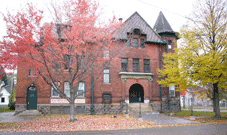



The History of Mary Sheldon Ismon House

Built in 1898-99, the Mary Sheldon Ismon House is a Historical and Architectural landmark. Described as "a looming brick Romanesque structure," this impressive three-story, brick-veneered frame building rests upon a coursed stone foundation. The building offers a Syrian arch entrance, an octagonal tower capped with a conical roof, stained glass windows, hardwood floors, and a full basement. Located at 300 S. Clinton, on the corner of W. Porter and Clinton Streets, the Ismon House is situated within Albion's designated Historic District and is listed as an eligible property in a National Register of Historic Places.

The building is named after Mary Sheldon Ismon, nee Peabody (founding family of Albion). Mrs. Ismon was an independently wealthy woman and an early member of the E.L.T. Club, a women's literary and cultural group organized in 1890 under the Latin maxim Emitte Lucem Tuam, "Send Forth Your Light." Due to the rapid growth of the E.L.T. Club in the early 1890's, Mrs. Ismon commissioned the Grand Rapids architect Sidney J. Osgood to draw up plans for a building that could house the burgeoning ladies club. The building was designed to provide meeting rooms for E.L.T. Club, as well as rooms where her husband and his friends in the Gentlemen's Leisure Hour Club could congregate.

During its first 100 years, the Ismon House accomodated three main Groups, a lending library under the auspices of the Albion Ladies Library Association until 1919, the ladies E.L.T. Club until 1967, and the Leisure Hour Club until 1999.

Originally a temperance organization, the Leisure Hour Club had the use of two bowling alleys in the basement and a handsomely furnished first floor containing a reception room, parlors, smoking and card rooms, and a large billiard room. The second floor housed meeting rooms for the E.L.T. Club and the Albion Ladies Library Association. This floor included the librarian's room and Albion's first lending library, which housed 2000 books donated by the members of the E.L.T. Club. The third story contained an auditorium with a stage and off-stage rooms, making it suitable for dramatic and other public presentations.

On February 22, 1899, shortly after construction was completed, Mrs. Ismon deeded the Club House to the city of Albion with the stipulation that the E.L.T. Club and the Leisure Hour Club each be granted a 99-year lease. In 1919 the City built a new library. After the lending library moved its book collection to the new building, the E.L.T. Club refurbished the second floor and remained active in the Ismon House until leaving in 1967.

The Leisure Hour Club continued to meet on the first floor of the Ismon House and in the 1950's installed a stand-up bar backed by a large mirror, acoustic ceiling, and new lighting, with dark paneling on the walls and over the windows. The Club maintained the building until its lease expired in the late 1990's.

Throughout the 20th Century, the Mary Sheldon Ismon House accommodated a variety of activities. For example, in the 1950's and 1960's, tumbling lessons were offered on the third floor, along with ballroom dancing lessons and formal dances for young gentlemen and ladies. And from the mid 1960's until well into the 1970's, the local golden gloves boxing organization trained young boxers in an improvised third floor gym. Prior to reconstruction in the early 2000's, the ceiling fasteners and chains that held the large punching bags were still visible.

At the close of the 20th century, the Ismon House remained an impressive, structurally sound and attractive building, with tremendous potential for community use. During the previous decades, however, both the exterior and interior of the building suffered from neglect due to a lack of sufficient funding to maintain the building's original grace, character and elegance.

In 1999, several events affected the status of the Ismon House:
- City Inspections revealed a number of code violations.
- The Leisure Hour Club's 99-year lease expired.
- The city of Albion assumed responsibility for the building.

When ownership and responsibility for the building were assumed by the city of Albion and transferred to the Downtown Development Authority (DDA), a group of concerned citizens sought to undertake the rescue, restoration and adaption of this Albion treasure.

The first order of business was to organize under the name 'Friends of the Mary Sheldon Ismon House'. The group successfully filed with the state of Michigan for incorporation as a membership organization and for certification as a 501(C)(3) non-profit, tax-exempt organization.

Members of the Friends Board attended several DDA meetings, and on July 13, 1999, the Friends petitioned the DDA to authorize The Friends of the Ismon House "to preserve, restore and maintain the Mary Sheldon Ismon House as a community center to meet some of the social, cultural, civic and educational needs of the Albion community." On November 9, 1999, the DDA voted to designate the Friends an official committee of the DDA, and delegated the group to proceed with plans for the restoration. Their goal was to adapt the Ismon House for use by all residents of Greater Albion.

A professional feasibility study was undertaken. Unfortunately, the Board discovered that the cost of full restoration would be more than one million dollars. When it became clear to the Ismon Board that it could not raise such a large amount of money, more modest plans were developed to proceed with the restoration, floor by floor.

Cleaning the interior of the building was the first major restoration task, involving dozens of volunteers over a period of several months. This work included disposing of roll insulation that covered the entire second story hardwood floors, removing years of dust and debris from all three floors, cleaning up the basement, and tearing out paneling and drop ceilings to reveal the structure and beauty of the building's original interior.

It then became clear that the entire building needed to be totally "deconstructed" before attempting to rebuild. Thus, the next major task involved deconstructing the entire infrastructure on all four levels. This included removing all lathe and plaster from walls, ceilings, and stairwells (along with 100 years of pigeon nestings), lighting connections and fixtures (gas and electric), bathroom and kitchen plumbing and equipment, furnace and air conditioning equipment, hot water pipes, radiators, etc. It took the next 2-3 years and tens-of-thousands of hours to complete this phase of the "Ismon Project." Hundreds of volunteers, skilled and unskilled, young and old, male and female, devoted themselves to this task.

In addition to the "sweat equity" of volunteer workers, residents generously supported the Ismon Project by donating over $150,000. These donations came from local individuals, organizations, businesses, foundations, and industries. Their contributions made it possible to begin the reconstruction work.

Once deconstructed, the rebuilding work proceeded on a floor-by-floor basis. Structural reinforcement was required that included installing major steel I-beams, metal posts, and cement columns. Using skilled volunteers and hiring local skilled tradesmen as needed, the 1st floor has now been completely and beautifully renovated and adapted to include handicap-accessible restrooms, large meeting spaces, a commercial kitchen, an office, a restored fireplace, entryway, and an elevator shaft. Finishing touches include Tiffany-style lighting, ceiling fans, oak flooring, heating and air conditioning, fire suppression, and a fire alarm system. By mid-year of 2006 the 1st floor was finished and "OPEN FOR BUSINESS."


Home Page About Us The Project Current Situation The Future Early Years